FLAGSHIP CASE STUDY · AiR
From a folder of specifications to an accountable release.
AiR is the gatekeeper between incoming work and what the portfolio is allowed to show.
A filename is not a build count. One specification can contain several systems, revisions and dependencies. The task is to preserve that structure, find the current master and keep every decision traceable.
Architecture and interactive demonstration. Not certification of a completed production pipeline.
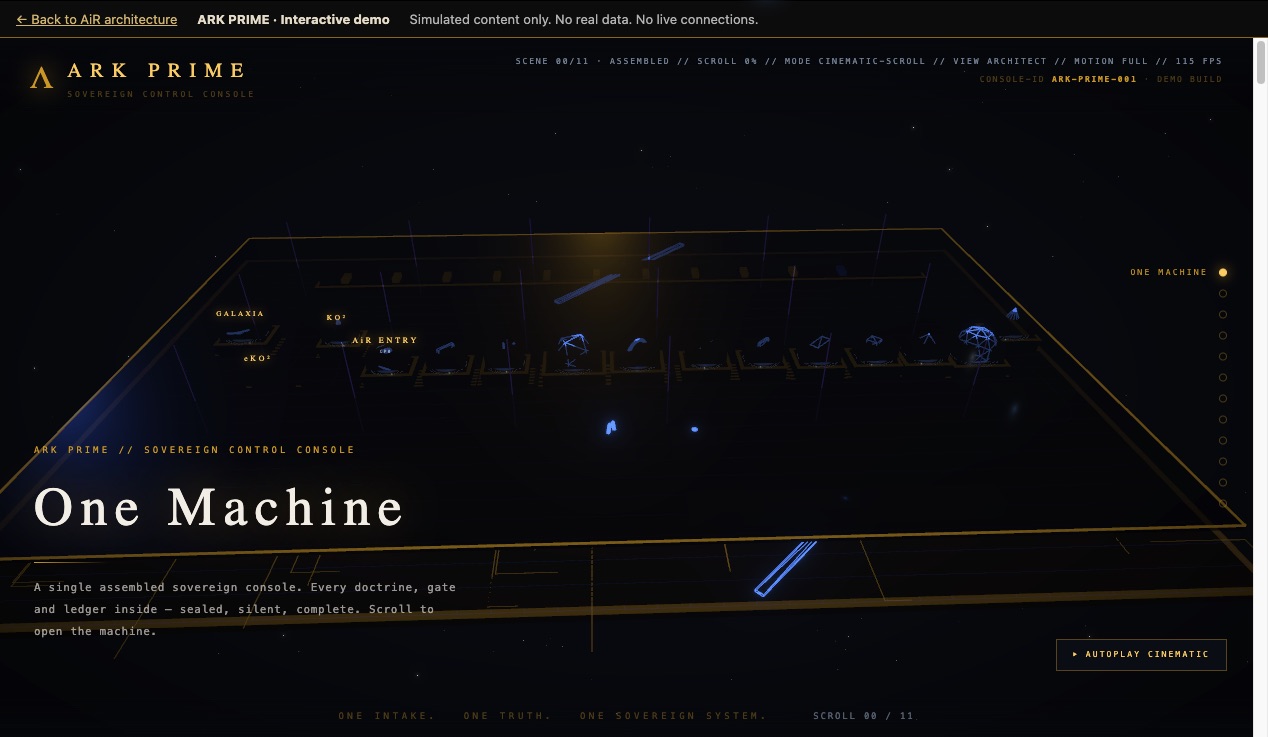
Experience the simulated pipeline Explore the supplied blueprint
The problem is lineage, not file counting.
Dense specifications, partial builds and older variants need to be understood together. Simply moving files into folders would lose the relationships the intake system is meant to recover.
The intended outcome is one current, graded master with its supporting material and history preserved, followed by checks that separate private work from a safe public projection.
The decisions that shape the pipeline
- 01
Read before counting
Extract document content, identify the build and its relationships, and retain provenance. OCR is needed for scans; readable source text should not be mistaken for an image.
- 02
Reconcile before grading
Relevant information from duplicates belongs with the master. Older material is preserved for reclamation, not treated as another finished product. Only the current master is graded; a changed master needs a fresh assessment.
- 03
Separate promotion from reclamation
The supplied blueprint branches at CP2. Promotion moves to CP4; remediation returns to CP2; hold stays held; reclamation enters CP3. DUST_BUNNI is one shared reclamation service, not a second promotion gate.
- 04
Make public release a separate boundary
Identity, custody and downstream checks remain distinct from publication. A successful intake or an attractive demo is not proof that material is cleared for public release.
A branching system, not an assembly line
Source boundary (CP0), raw-source canon and classification (CP1) lead to ArkLex and CP2 adjudication.
CP4, ArkChain, Registry and CP5 establish the intended identity and custody path. Object doctrine and final checks lead through CP6–CP9 toward public egress.
Remediation loops back to CP2. Parking has no implied release. Reclamation goes through CP3, DUST_BUNNI and ClawLab, with cold archive and a return toward CP1 shown in the blueprint.
Living report cards, ArkLedger and doctrine enforcement cross the flow. Dotted connections in the source are not silently converted into executable routes.
Where processed work belongs
- ArkHyv: current, active, graded masters and their report cards. Ungraded documents do not belong here.
- Dust_Balls: older variants and material available to DUST_BUNNI for reuse, improvements and spare parts.
- PageMaster: portable HTML documents retained as independent presentation backups.
- The App_Shak: builds intended for shared Ark-wide application access, rather than ownership by one computer.
These are the Architect’s routing requirements, not a claim that every destination and cross-machine handoff has passed acceptance testing.
What can be demonstrated, and what still needs proof
The local portfolio contains the branch explorer, interactive simulated console, text-only alternative and links between the case study and supporting records. These are presentation features.
The Architect’s intake, master-grading and custody requirements, plus the supplied CP0–CP9 governance flowchart. The demo follows the promotion/reclamation distinction.
Production OCR selection, semantic training quality, duplicate merging, grading accuracy, every downstream service handoff and an unattended end-to-end public release.
Run representative long documents, scans, conflicting duplicates and changed masters through the real chain. Retain stage receipts, test failures and holds, and confirm that no ungraded or uncleared content escapes.
Source basis: Architect’s requirements, 5–10 November 2026; supplied governance blueprint inspected 13 November 2026. No live records, private case details or operational endpoints are embedded.
Open the concise architecture record · Read the portfolio verification record