FLAGSHIP CASE STUDY · SONIC SP³
The record deserves to be heard.
A legal-support operating environment built around a simple discipline: evidence before argument.
Sonic brings evidence organization, chronology, research support and drafting into one product direction. The aim is clarity under pressure, without turning an inference into a fact or a draft into a court action.
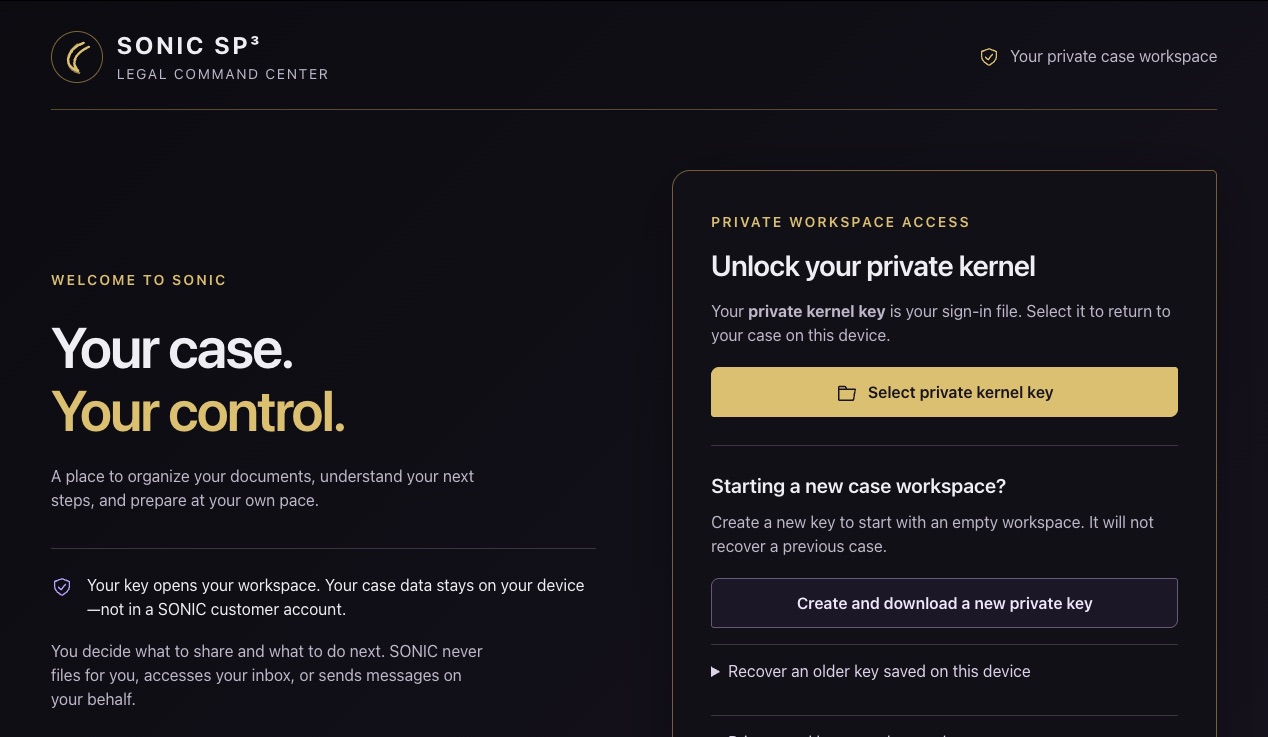
Product scope and source artifacts are documented. A public landing was observed; the integrated legal workflow has not been certified here.
Walk through the intended workflow Open the public landing ↗
A pile of documents is not yet a usable record.
Messages, forms, screenshots and dates can describe the same event differently. Useful support must make those relationships inspectable, preserve contrary material and show the gaps instead of smoothing them away.
The original product narrative asks for a disciplined environment that helps a person see what they have, what remains uncertain and what needs human review. Private circumstances are not needed to demonstrate that design.
Keep the distinctions that matter.
An original remains identifiable and unchanged. OCR, summaries and other transformations belong to traceable working records.
A documented event, an interpretation and an unresolved contradiction need different labels and visible source references.
Evidence and chronology belong to their own matter. Isolation is a required control, not a claim that a displayed interface proves it.
Preparing an exhibit list or draft packet does not mean it was filed, served or admitted. Those statuses require their own evidence and human authority.
From intake to a reviewable packet
Intended workflow, transcribed from the supplied product narrative. This is an explanatory walkthrough, not a live matter or a runtime test.
- 01
Open the right workspace
Establish the matter context and mark missing information. Keep it separate from other records.
- 02
Preserve the sources
Receive documents, retain receipt details and make transformations inspectable. Uncertain OCR or metadata stays visible.
- 03
Connect a chronology
Link dated entries to supporting sources. Approximate dates and unconfirmed identities stay qualified rather than becoming authoritative through repetition.
- 04
Expose gaps and contradictions
Show both supporting and contrary material. A chronology is a navigable index, not a verdict.
- 05
Prepare for human review
Assemble a draft chronology, evidence index and questions for review. Preserve verified exhibit labels; keep new material in staging until checked.
- 06
Leave with honest next steps
Separate what the sources support, what remains disputed and what requires qualified human or official-source verification.
One environment, distinct responsibilities.
The source describes command-center, timeline and evidence-workspace surfaces. Evidence Hunter remains a distinct evidence-product lane until a verified integration establishes otherwise. Interface artifacts, evidence tooling and a unified operating environment are related, but not interchangeable claims.
Portability is a design goal: the record and its boundaries should remain understandable beyond one interface. Broader deployment or additional jurisdictions would require their own validated controls.
The proof stays attached to its claim.
The supplied Sonic portfolio narrative describes the product boundaries, workflow and artifact inventory. The public landing was opened and captured in the designated browser on 13 November 2026.
The narrative reports command-center and evidence artifacts, schemas, local tooling and a package test report. That report is not presented as a fresh test run or an independently verified integrated service.
End-to-end matter processing, authoritative court-data connections, production security, complete runtime behavior and deployment of every described component.
Use an explicitly fictional record to verify source preservation, matter isolation, chronology links, conflicting evidence, draft labels and export provenance. Retain the result of each check before making broader claims.
Sonic is not a law firm or a substitute for a licensed attorney. Organization and drafting assistance do not confer authority to file, serve, sign or represent anyone.
Read the concise Sonic record · Read the portfolio verification record